Get Investor Portfolio
Major financial institutions and Private investors have integrated Bitcoin into their core asset management offerings, driving professional-grade efficiency into the market. In , investor portfolios are being reshaped by institutional adoption of Bitcoin and the rapid rise of decentralized finance (DeFi). Major financial institutions and private investors are now integrating Bitcoin into core asset management strategies, bringing professional-grade efficiency and liquidity into the crypto market.
Institutional Power Players
| Institution | Role / Product | Key Development |
| Morgan Stanley | MSBT ETF | Launched the Morgan Stanley Bitcoin Trust (NYSE Arca) in April 2026, marking a full-scale pivot to in-house crypto products. |
| BlackRock | IBIT ETF | Remains the global leader; as of early 2026, BlackRock’s IBIT holds over 565,000 BTC (approx. $52.8B AUM). |
| GSR | Core3 ETF | Launched the first actively managed multi-asset crypto ETF (BESO) tracking Bitcoin, Ethereum, and Solana with built-in yield strategies. |
| Goldman Sachs | ETF Market Making | Now a primary participant in the crypto ETF field, providing deep liquidity for institutional entries/exits. |
Market Highlights
- 1.26 million BTC held across US Bitcoin ETFs
- $91.8 billion total ETF assets under management
- $767 million weekly inflow surge in March 2026
Top Corporate Bitcoin Holders
- MicroStrategy: Remains the undisputed king with 762,099 BTC (valued at over $46B)
- Twenty One Capital: A newer major player holding 43,514 BTC.
- MARA Holdings: Holding 38,689 BTC, representing the integration of mining operations with balance sheet management.

The DeFi Advantage
- Capital Efficiency: Composability isn’t just a cool concept—it fundamentally changes how productive each dollar is. In traditional finance, capital is single-threaded Stocks → sit idle unless sold or margined (with restrictions) while Money in a savings account → earns interest only.
- 24/7 Markets (True Real-Time Finance): Traditional markets operate on human schedules. DeFi operates on network uptime. This changes behavior in three important ways: Instant Reaction Time, Continuous Yield Optimization, Global Price Discovery. Crypto markets don’t “pause,” so pricing is: Constantly updated,Globally synchronized Efficiency gain: No dead time. Capital is always active, never waiting.
- No Middleman (Maximized Yield Capture): Traditional finance layers look like this: User → Bank → Broker → Clearinghouse → Counterparty. Each layer takes a cut. DeFi compresses this to: User → Smart Contract. Key idea: You’re not just a customer—you’re the liquidity provider, effectively acting as the bank.
- Global Access: DeFi removes the traditional barriers like: Geographic restrictions, Minimum capital requirements and Accreditation rules. this unlocks Advanced Strategies for Everyone. you can access: Yield farming, Leveraged positions, Derivatives and Automated market making (AMMs) From just a smartphone and a wallet. Efficiency gain: Capital allocation is based on strategy, not status.
- Transparency (Real-Time Risk Awareness): In TradFi, you rely on: Quarterly reports, Audits, Credit ratings All of which are: Delayed, Sometimes opaque In DeFi, everything is: On-chain, Verifiable, Real-time. you can see the Total value locked (TVL), Collateral ratios, Liquidity levels and Large wallet movements (“whales”). this matters because You can identify: Over-leveraged protocols, Liquidity drain and Unusual activity Before collapse. Efficiency gain: Reduced information lag = faster, smarter capital movement.
Diversified Investment Portfolio
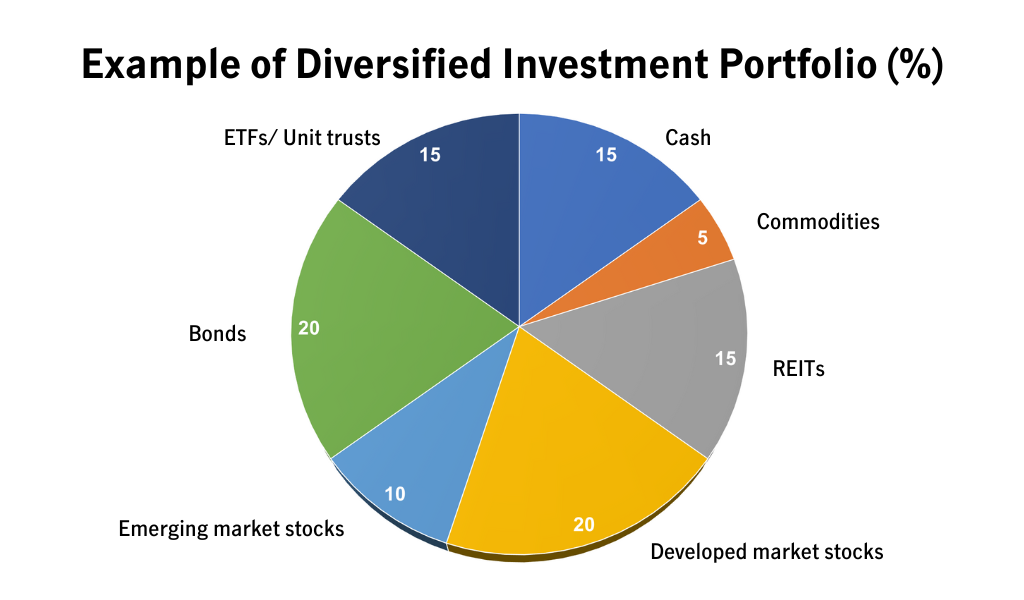
Diversification applies to both the stock and bond portions of a portfolio. On the stock side, it means owning shares of U.S. and international companies of different sizes and in different sectors. Bond funds are composed of government bonds, corporate bonds, and municipal bonds, among others.
Having a balance of lower-risk assets like bonds and higher-risk assets like stocks allows a portfolio to grow while providing a cushion against volatility. While stocks offer higher expected returns over the long run, they can experience substantial short-term swings. High-quality bonds, on the other hand, tend to generate lower returns but may provide stability. A diversified portfolio reduces overall risk while still allowing for long-term growth potential. Of course, a diversified portfolio approach may underperform relative to a winning investment, but it may provide stability and can help you sleep at night.
Asset Allocation
A diversified portfolio starts with the understanding that you'll have a variety of asset classes. The percentage you invest in each asset class depends on your risk tolerance, time horizon, and goals. Here are three commonly used allocation strategies that reflect varying levels of risk and return:
- Conservative: 80% stocks/20% bonds
- Moderate: 60% stocks/40% bonds
- Conservative: 40% stocks/60% bonds
A higher stock allocation may provide more growth potential but also greater volatility, while a higher allocation of bonds may increase stability but may dampen long-term returns.
Final Insight
A modern investor portfolio is no longer just about holding assets—it's about actively managing capital across both institutional products and decentralized systems. By combining ETF exposure with DeFi strategies, investors can maximize efficiency, liquidity, and long-term growth potential. While DeFi is hyper-efficient, it shifts the burden of security to you. In this world, you are the IT department and the Security Officer. If you lose your private keys or sign a malicious contract, there is no "Forgot Password" button or customer support to call.
Are you looking to set up a specific type of portfolio, like one focused on passive stablecoin yield, or are you aiming for more active growth?